Circadian rhythm
Know when to focus, rest and sleep.
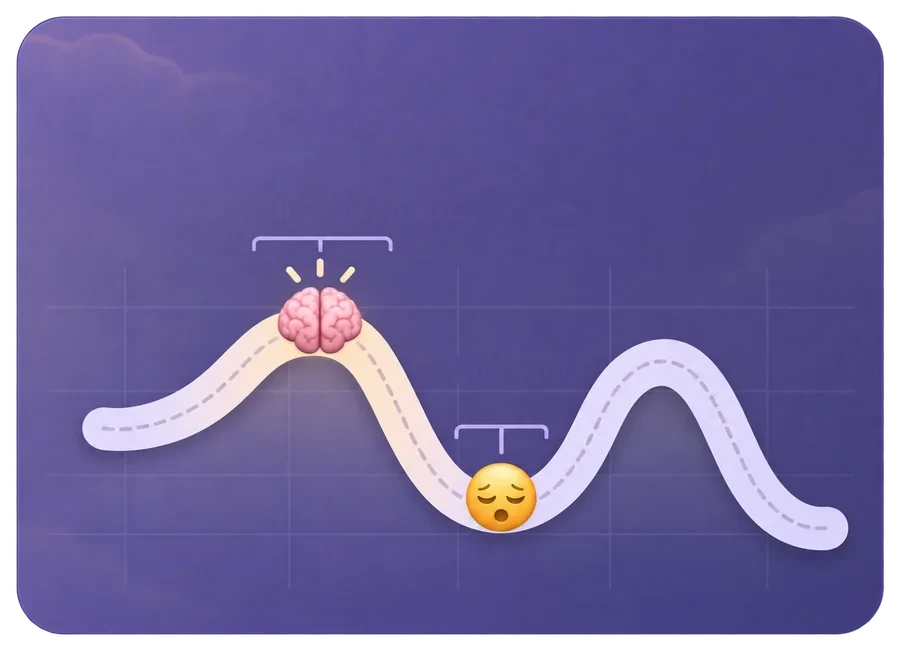
Rhythm, in Wonderwake, maps your day on one simple arc: when energy tends to peak, when the afternoon dip arrives and when it’s time to wind down. After a few nights, it finds your chronotype from your own sleep.
 Download on theApp Store
Try for Free
Updated
What you get
-
Your day on one arc
From 6 am to midnight, with your likely peaks and dips marked along the way.
-
Your chronotype
From Early Lark to Night Owl, found from your own sleep after about five nights.
-
Tips for right now
Short cards that explain the part of the day you’re in and what might help next.
The basics
What is a circadian rhythm?
Your circadian rhythm is your body’s roughly 24-hour clock. Together with sleep pressure, the need for sleep that builds the longer you’re awake, it shapes when you tend to feel alert and when you tend to feel tired.
Many people feel a strong stretch in the morning, a dip in the early afternoon, a second wind later in the day and a natural slowdown in the evening. The exact timing differs from person to person.
Light is the main signal that keeps this clock on time. Daylight in the morning helps set it, while bright light late in the evening can push it later.
Rhythm in Wonderwake
How does Wonderwake map your energy through the day?
Rhythm draws your day as an arc from 6 am to midnight and splits it into parts you can feel:
- Morning rise and Morning peak. You come out of sleep, then often reach your clearest hours.
- Post-lunch dip. A natural lull in the early afternoon, often stronger after a short night.
- Second energy peak. A lift later in the afternoon.
- Evening descent. Things start to slow down toward bedtime.
- Sleep Gate and your sleep window. Your best time to go to bed, and the night that follows.
Tap Now to read about the part of the day you’re in, or drag along the arc to look ahead. The arc is anchored to when you actually wake up and go to sleep. Without sleep data, Rhythm shows a general curve; with it, the timing becomes yours.
With Apple Weather connected, today’s real sunrise appears on the arc, and tips can take rain, snow or cold into account.
Chronotype
What’s my chronotype?
Your chronotype is your natural timing: whether your body leans toward early mornings, late evenings or somewhere in between. Wonderwake finds it from when the middle of your sleep usually falls across recent nights.
After about five nights of sleep data, from Apple Health or just your iPhone, your chronotype is ready and you reveal it with one tap. If your sleep timing shifts for a week or more, it can shift with it, but one late night won’t change it.
Five chronotypes
From Early Lark to Night Owl.
-
Early Lark
Dawn-tuned. Your energy rises before most alarms do.
-
Soft Lark
Morning-leaning, gently. You rise with light, not force.
-
Third Bird
Balanced in the middle. Your rhythm follows the daylight.
-
Soft Owl
Evening-leaning. Your best hours arrive after the morning fog.
-
Night Owl
Night-tuned. Your focus wakes up when the day winds down.
In everyday life
How can you use your rhythm?
Each time you open Rhythm, three short cards explain the part of the day you’re in and suggest what might help, like getting daylight in the morning or keeping the evening dim. They take your recent sleep, sleep debt and activity into account.
- Plan the hard stuff for a peak. Save focused work for your morning peak or second energy peak.
- Go easy during the dip. Lighter tasks, a walk outside or a short nap fit the early afternoon.
- Wind down on time. Dimmer light and fewer screens as you approach Sleep Gate make it easier to fall asleep.
Rhythm is a guide to likely peaks and dips, not a measurement of your energy.
Questions
Circadian rhythm FAQ
What is a chronotype?
Your natural timing for sleep and alertness. Early types feel best early in the day, late types hit their stride later. Wonderwake sorts it into five types, from Early Lark to Night Owl.
How does Wonderwake find my chronotype?
From when the middle of your sleep usually falls. It needs about five nights of sleep data from Apple Health or your iPhone.
Do I need an Apple Watch for Rhythm?
No. Rhythm works with just your iPhone. A watch or ring can make your sleep times more precise.
Why do I feel tired after lunch?
Many people have a natural dip in alertness in the early afternoon. It’s part of the daily rhythm and tends to be stronger after a short night. Rhythm shows when your dip is likely to land.
Can my chronotype change?
It’s partly built in, but light, sleep timing and routine can shift your rhythm a little. Wonderwake updates your type only after a steady change, not after one late night.
Is the energy curve personal?
It starts from a general curve and follows your own wake and sleep times as data comes in. It shows likely peaks and dips, not a measurement of your energy.






For everyday routines and general wellness only. Sleep times, stages, scores and recommendations are estimates, not medical advice, diagnosis or treatment. Wonderwake does not detect sleep disorders or guarantee sleep results. Ask a qualified professional about persistent sleep concerns.
General information on sleep and the body clock is based on: NIH: sleep–wake cycle , NIH: your body clock , CDC: the afternoon dip , Reyner et al., 2012